Saturday, 19 January 2013

The Word Master Challenge: How Not to Write a Novel Beginning

The challenge, from Misha Gericke's blog My First Book:
In less than 300 words, I want to see your idea of the WORST beginning you can possibly write. The funnier and more creative you are, the better. To make it easier for me, you have the WHOLE of January to enter, but you must please enter the SPECIFIC entry link into the linky list below.


My entry:
Ediana's Diary
Dear Diary,

I wrote as I stared fixedly out the window,

Today happened as usual, Princess Sarelihta woke us to bring her tea, we brought it as usual. Like I said, nothing interesting.

Princess Sarilehta makes us write diaries to check we like her. Naturally, we don’t write that we hate her. I am Princess Sarehlita’s maid, servant, slave, whatever. So are Sarihna, Gadkinalia, and Eve. Well, we’re slaves but she would never call us that.… Whatever. Back to the diary.

The day was the same as always. Routine.

I HATE ROUTINE!!!!! I don’t know why people invented it. The same thing, every day. BORING!!!!!!

I stared out the window. The view was the same as every other day. The stables, the forest the lake and far in the distance, the mountains. There’s also the town, Capiton, on the river. Further down there’re more towns, and then it goes up to the mountains. I thought about exploring it all, but I knew I would never escape from here.

I was taking the breakfast things down when I first saw him. I do that every morning. Bring Princess Sarelita her tea, prepare her bath, get the breakfast, and bring it down, all the boring stuff. And we also did whatever else she told us.

The drawbridge opened. A lad, who looked about sixteen, suddenly came in, Perhaps, I thought, he’s bringing interesting news. There could be something interesting happening…

He had onyx hair. “Do you know the way to the royal dining room?” he queried me.

“That way. I’m going there right now, but if you plan to go, I suggest you get out of your travelling clothes and have a bath, first. Her majesty can’t stand it if you come without washing yourself. I tried it once.”


Tuesday, 15 January 2013

A Foray into Fanfiction


For a long time – although I have had a fanfiction.net account since 2006 – I have been a bit wary of writing fanfiction in a serious way. When I read novel-length fanfictions, while I have the greatest respect for their authors, I find myself wondering: if you had the time and energy to write that much, and then make it into something decent which you would feel comfortable putting out to the world, couldn’t you write original fiction? It seems to me like a terrible waste of good writing to use it on someone else’s characters rather than your own.

Many writers out there who suggest using fanfiction as a way to improve your writing without having to worry about serious things like character development, or worldbuilding. I always figured – wrongly – that this was for people who wrote for completely different reasons to me. I love worldbuilding and creating characters, and so I thought it didn’t apply.

As it turns out, I was entirely wrong. As I have mentioned in the past, I’m in the process of editing the first draft of a 115,000 word novel-in-progress. I wrote a post last week detailing my methods, but honestly, I haven’t a clue how to go about it. I’ve been reading a lot of writing blogs and advice by published authors on how to edit in the hope that they will explain this to me. Things like how one should cut ALL the adverbs, never, ever use a dialogue tag other than ‘said’, and remove every sentence that doesn’t serve at least two purposes. I don’t know, at this point, whether any of these things are true. I don’t mind adverbs, but I know that I horribly overuse the word ‘suddenly’.  I read a fanfiction the other day in which someone ‘tsk’ed an entire line of dialogue, and I recognise this isn’t physically possible, but I’m sure words like ‘exclaimed’ and ‘whispered’ exist with good reason. And as for the last one, I just don’t think that I can.

Without any practise, I don’t know yet what works in writing, or what works for me. If I start on a 115,000 word monstrosity, it will take me a long time to work it out. What with the two-and-a-half years that it took me to write the thing, the year-and-a-half it’s taken me to start editing, the whole writing process isn’t going to make sense to me any time soon. On the other hand, if I start on a 300 word drabble, I’ll know have a mini snapshot of the writing process in a much shorter space of time.. And then I shall apply it to my novel-in-progress.

That is, at least, the plan.

(And guys, by the way, read my fanfiction. It’s an Eponine/Cosette fic, of sorts.)

Tuesday, 1 January 2013

How to Edit a Novel


After months of procrastination, I’ve finally decided to get back to editing my 100,000 word draft of what may one day become a legitimate novel. In honour of this venture, I’m writing a post on how I’ve been going about editing so far. The title is probably a misnomer, since I haven’t done enough to be sure if this is a definitive way to edit. I’ve also only covered how I’m going from draft one to draft two, which is very broad editing, rather than nit-picking prose. I figured I’d write down what I’ve done  anyway, in the hope that it will help someone out there to edit their own novel.

1. Read your novel
This step is deeply unnerving. It may make you cringe a lot. On the other hand, you’ll also hopefully discover your favourite parts of your novel, and remember what you like about it, in order to know what to keep. I also got my sister and a friend to read it and highlight the parts which they would be very sad if I deleted. I wrote a post a while ago about how I felt like in editing I was getting rid of all my favourite parts of the novel, so I thought this was a very important step to do. I also often feel like authors don’t realise what makes their work amazing, and so I think it’s good to get feedback on what you’re doing right before you change it.

2. List your scenes
This helps to get everything straight in your head, and to organise things on paper. I did it in an Excel spreadsheet under these headings:

  • Scene number
  • POV
  • Setting
  • Plot points (this one is good for pinpointing scenes that have no plot points, so you know to change them later)
  • Characters (I gave each character their own column, so I could tick of what scenes they were in, and make it easier to sort the spreadsheet and do step three)


3. Streamline your plot
I did this first of all by writing out the plot, as simply as I could, from the perspective of each of the main characters, not including anything which didn’t have an effect later on in the book. Doing it separately by character probably isn’t necessary for everyone, but I was writing a novel which was based on who knew what, and when, and it was getting horrendously inconsistent. It’s also handy for making sure your characters all have motivation.
After that, I wove together all my streamlined character-plots into one logical, coherent plot.

4. Write a new scene list
This step is pretty self explanatory. I modified my scene list to include the new scenes I needed to make the plot make sense, cut the old ones that weren’t relevant, and modified which needed modification. I was pretty harsh with cutting at this point, only keeping scenes in my list which were absolutely necessary. I think I came out with about a third of the scenes I originally had, but I’ve been adding more scenes in as I go along. At this step, though, I wanted it to be as clear and concise as possible.

5. Open a blank document
Copy in the scenes from your first draft that just need a bit of tweaking. Write in the new scenes that you need. These are the difficult part, on which I offer no advice. Good luck.

Monday, 24 December 2012

Les Miserables or Why the book isn't always better than the film


As I mentioned the other day, I had been frantically reading Les Mis in order to finish it before I saw the movie. Unfortunately, I saw the movie yesterday, with 200 pages still to go. But 200 out of 1300 isn’t too bad, so I’m quite happy, all things considered. So now, having read most of the book, watched way too many videos of the musical on YouTube, and seen the movie, I am in a position to judge which is superior.


To begin with the book, it is bloody long. 1300 pages of long, interspersed with, among other things, a forty- page description of the Battle of Waterloo, a thirty-page history of a relatively unimportant convent, and a forty-page character sketch which Hugo assures you “in no manner concerns, even in the remotest degree, what we have to relate.” Every scene of action or dialogue is bookended by a treatise on philosophy, history or politics, given either by one of the characters, or shamelessly by Hugo himself. (He also indulges in some shameless self-promotion of his family, with asides totally unrelated to the plot, such as this “….for the space of two hours, the heroic Captain Louis Hugo, the uncle of the author of this book, sustained alone with his company of eighty-three men every effort of the hostile army.”) The book basically reads like Victor Hugo decided to write a novel, wrote everything that came to his head for the next ten years – political thoughts, character sketches, backstory, etymology of his characters’ names, the occasional piece of genuine plot – and then gathered it together into a vaguely chronological order, and by some sheer fluke managed to get it published. Other books leave the readers with lingering questions to inspire them to write fanfiction. In any other novel, you might be able to ask yourself – Why did Cosette’s father leave Fantine? Has Enjolras ever been kissed? What is the etymology of Valjean’s surname? But not in this novel! Any thought Hugo ever had regarding his novel, you’re going to know about.


That's much more like it, Marius.
It’s difficult to say whether the expansive, rambling and occasionally incredibly implausible plot of the book is better than the cut-down plot of the musical and the movie. The Eponine-Marius-Cosette love triangle, which really annoyed me in the novel, is greatly improved. Book-Marius has nothing to his character except love for Cosette, and is only interested in the barricade as a way to die when he thinks he’s left her. He’s also an emotionally abusive boyfriend. (“I give you my most sacred word of honor, that if you go away I shall die.” Not on, Marius. Not on.) Musical-Marius is a passionate revolutionary who struggles to choose between his girlfriend, and his friends on the barricade. His relationship with Eponine also changes from a random girl who loves Marius basically on sight to a good friend who provides a genuine  alternative love interest for Marius. In this respect, the writers of the musical did a much better job that Hugo.


On an aside, Hugo wouldn’t know how to characterise a female character if he found one floating in his tea. One day, Cosette looks in the mirror and decides that she’s beautiful. The next: “She at once acquired the whole science of the bonnet, the gown, the mantle, the boot, the cuff, the stuff which is in fashion, the color which is becoming, that science which makes of the Parisian woman something so charming, so deep, and so dangerous.” Yes, Victor Hugo, this is exactly how being a girl works. When she sees a bird making a nest with its mate, she feels “the deep restlessness which a nest gives to a maiden.” Yes, Hugo, all girls work like this, too.


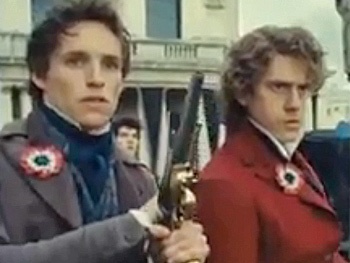
This is sadly the best picture I can find.
He is really much prettier than this.
On the other hand, the revolutionary students, who are some of the best characters in the book, in my opinion (and also some of the few realistic ones), are nothing more but faces in the movie. You miss out on a lot of the rapport between them, and I don’t think you get nearly as much understanding of the fact that as well as being passionate republicans, they’re also just a bunch of friends who like to get drunk and talk politics. I felt like I didn’t get a chance to get to know them before they all died (because remember: everybody dies). I didn’t actually have this problem the first time I saw the musical, before reading the book, but once you know the names of all the revolutionary students, you feel really sad when they only mention the names of two of them. (But don’t worry, because Grantaire is a babe). 

Basically, a movie can’t possibly provide the same depth of character a book can. It can characterise better, as in the case of Marius and Eponine, but it can’t really characterise more. You can fit as much into a book as you want. In a movie, you’re limited by the amount of time people are willing to sit in a cinema before their eyeballs fall out. But that also means that a movie has to streamline and tighten plot, and to keep on topic, which I don’t think it would have hurt Victor Hugo to do just a little bit more.


At the end of the day, the book is too long, but the movie is too short. (Honestly, it would probably make a great TV series). On the plus side, when you read a book, you get to choose which parts you pay attention to, and which parts you skip, whereas if you watch a movie, someone else does the choosing for you. And honestly, I really enjoyed the Battle of Waterloo. I feel educated now. Overall, though, it’s probably best to take book, movie and musical as a whole. The book has deeper characterisation, more complex plot, and will provide you with a thorough grounding in the history of France. It also takes weeks to read. The musical has better characterisation, amazing songs, and lasts for under three hours. And the movie? The movie has Grantaire’s face.