Showing posts with label Nanowrimo. Show all posts

Monday, 27 October 2014

Stuck in Western Europe (a return from a very long hiatus)

My sister and I have a drinking game. We go into the fantasy section of our local library, and we take turns picking a random book of the shelf and reading the blurb. If the book you pick is set in a standard, somewhat Tolkien-inspired medieval fantasy world (a few dragons, a lot of feudalism, and a strange resemblance to Western Europe), you take a drink.

If we took the trouble to smuggle drinks into our local library, we would end up totally smashed.
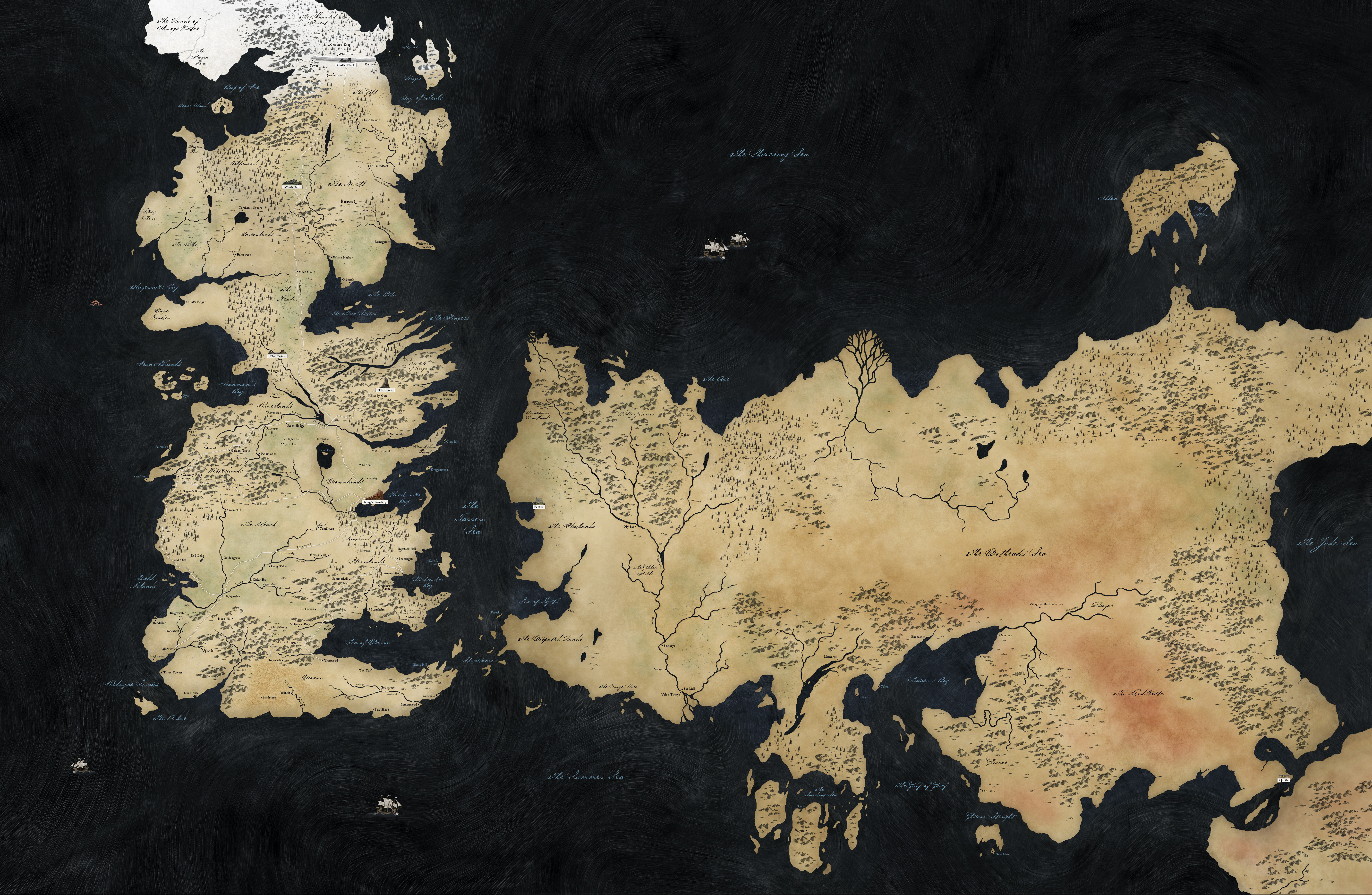
The easiest way to illustrate this point is to look at some maps:
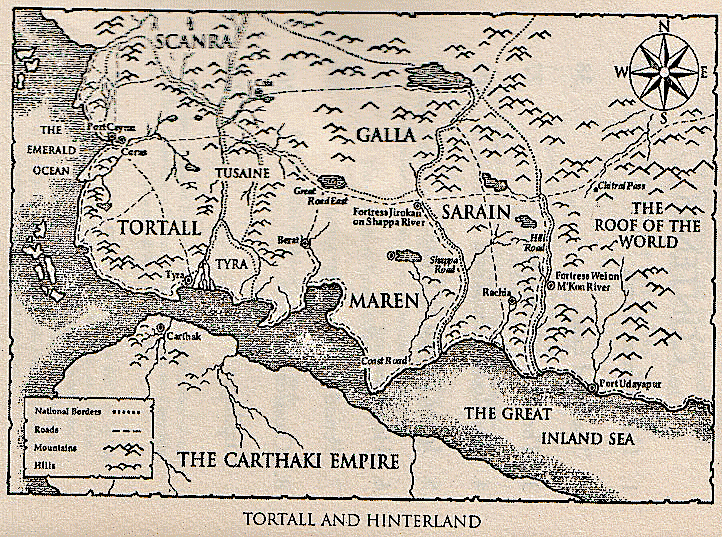
Tamora Pierce's Tortall (source: tamorapierce.wikia.com)
John Flanagan's Ranger's Apprentice world (source: rangersapprentice.wikia.com)
George R. R. Martin's Westeros and Essos (source: gameofthrones.net)

Are you seeing a resemblance yet? (source: aventalearning.com)
Whether you call it the Great Inland Sea, the Constant Sea or Slavers' Bay, we're looking at the Mediterranean. So why this obsession with medieval Western Europe?


The most obvious answer is that Tolkien did it first. But there’s a slightly more complicated one. The imagined medieval Western Europe is a very familiar place to all of us, not just within the fantasy setting. It’s the location of most of the fairytales we grow up on. It’s the home of King Arthur. If you ask someone to tell a small child a story, the chances they will start with ‘Once upon a time there was a princess living in a castle’ are very, very high. Medieval Europe is not an exotic world that we have to research, or to think about really hard. Since the late medieval story-tellers looked back at the early medieval period and saw an idealised image of knights slaying dragons to win the hands of maidens, it’s been the playground of western story-telling, and so most of us think we’ve got a pretty solid grasp on the medieval world. Thanks to a strange quirk of European culture and historiography, we can lump anything from the early-mid-first millennium all the way to the Renaissance into one supposedly cohesive setting under the ‘medieval’ label, without have to fret too much about whether they’d invented plate mail yet, or how powerful the crossbow was at such and such a time. Chances are nobody will question it. It’s been standard fare for far too long to seem odd.

I haven’t written a medieval fantasy in many, many years. But there’s more to this phenomenon than just the medieval. I sat down to start planning my Nano for this year, and I decided – as I so often do – to write something steampunk. As the people of the fourteenth century invented the chivalric past of the earlier medieval period, I turned around to see an idealised Victorian era - one focussed heavily on the science and progress of the industrial revolution, where nobody ever dies of typhoid.
And so I started out, and I imagined some characters, and I thought about the world they would inhabit, and I assumed it would kind of resemble Victorian Britain. I didn’t even think about this, it just seemed obvious. Want to write a fantasy novel? Set it in medieval Europe! Feeling adventurous. Want to write a steampunk novel? Why move! So vaguely British it was. Nothing specific. Just somewhere where people say things like ‘By Jove!’ and wear top-hats, and there’s some steam-powered stuff, and everyone acts like it’s kind of new and exciting.

That same day, however, while I was doing data entry at my local historical society, I found several files on a magician (unfortunately a stage magician, but I chose to ignore that part of the story in favour of imagining a genuine magician) in Australia in the first half of the twentieth century. He had all kinds of problems unique to his time and place – he struggled to sit his wizardly exams, because there weren’t enough examiners out in the colonies, and those who were there all knew each other, and therefore couldn’t be considered unbiased. He waited weeks, and sometimes months, to receive news from the international magic community. He worried about the decline of magic in the face of exciting new technology. He spoke about the role of women in the magic community. He closed his business during World War Two, because rationing meant he simply couldn’t get hold of the materials he needed.

I contemplated writing a novel about this man, with real magic instead of stage magic. It would be very exciting, and it would be very unique. When was the last time you read a novel about a magician in early twentieth century Australia? Exactly. And when was the last time you read a novel about a magician in a world vaguely based off Western Europe? Well, if you read much fantasy, probably not very long ago at all.

So with this magician in mind, and I turned around and looked at my Nano plan, and I thought – why Britain? Why Western Europe? I’m not British. I’ve only been there once, and that was entirely by accident. And yet I have this idea that if I wrote in Britain – or Western Europe at all – it would be easier. I wouldn’t have to research, and could just write my story, because I pretty much know how Western Europe works – since we started writing about dragons and princesses, ambiguously-dated Western Europe has been the home of fantasy stories.

But if I wrote in Australia, the country I have lived in for my entire life? That would require research. I would have to think about that. I would have to navigate things that haven’t been navigated before: How do Indigenous cultures relate to wizards? How do you build an airship when you’re in a backwater colony in the middle of nowhere an shipping anything over takes months and months? How to you confine a convict who has magical powers? Do we still even have convicts? What year is it? What’s happening in politics? Has Federation happened yet?

And this is where we hit a wall – Australia suddenly seems too specific for a fantasy novel. Suddenly I’m not just writing a fantasy novel, I’m writing an ‘Australian fantasy novel’. But why should Australia be considered any more specific than Britain, or Western Europe? The only answer is that Australia isn’t the default for anybody’s writing, and so there’s no ‘generic Australia’ construction in our general imaginations. Australia needs dates and names and thought, because you’re deviating from the default, and people can’t just place your story in the ‘standard Western Europe’ that they already keep in their heads. To set your fantasy outside of the standard Western European setting, you need to construct your own unique setting from the ground up. You’ve got no default to fall back on.

So I’m picking up my story out of Western Europe, and moving it to a fantastical Australia. It will require some thought, but hopefully I’ll also be writing a better novel, a more unique novel with a stronger setting and less temptation to fall back into lazy tropes. Because other places deserve their fantasy novels too.


(Side note: while writing this post, I got off on a very long tangent about Australia's inferiority complex, and how it manifests itself in our attitude towards the Australian accent. If anyone's interested.)

Wednesday, 21 November 2012

Reports from the No-Longer-Novelling Front, and a Book Review


Nanowrimo

So I’ve given up on Nanowrimo. Turns out that having done Nano four years running does not qualify you to do a double-Nano. Some people have this kind of stamina. I do not. I will know this for next time, because it really isn’t worth the effort. I probably ought to have just made up my mind on one novel at the start of the month, accepted that I could write the other one at a later date, and moved on. And then, feeling overwhelmed by trying to write two Nanos and an essay on Livy, I decided to take a few days off. On the plus side, I learnt a valuable Nanowrimo lesson:  I should never take days off. Especially not when there is good weather, and I end up sitting outside, thinking thoughts like ‘Why would I want to go inside and write a novel?’ and ‘Ceebs.’

 Surprisingly, something else which I think may have potentially been a problem is the fact that one of my novels was meticulously planned, down to detailed scene lists. I think I felt less motivated to write because I already knew what happened, and so my characters will never be stuck in awkward limbo where no-one ever finds out how they resolve things. I know how they resolve things, and I wasn’t interested enough in exploring it in more detail. I hadn’t actually predicted this negative outcome of planning, but there you go. Perhaps I’m doing it wrong. Perhaps planning just isn’t a thing for me. I’m not entirely sure, but I think it may just have been the fact that my plan was so detailed that it was stifling anything unexpected. There is probably a nice balance I can find.

Honestly, though, it’s not all bad. I’m not exactly lacking in first-draft manuscripts that seriously need editing. One is hiding on my computer not being looked at, one is in the middle of becoming a second draft, and one is waiting to be converted into a musical. and then there’s a screenplay waiting to become a web-comic. And a half-finished novel about uber-talented artistic prodigies at boarding school. It don’t think I actually need Nanowrimo to make sure I write things at this point. Things get written. Now they just need to be made good.

And then, of course, there was the curse that strikes so many Wrimos – I had a brilliant idea for another story, that would be so much more fun to write. I call it ‘Cicero and Enjolras Solve Crime’. It will be amazing.

And now for a book review…


The House of Silk – Anthony Horowitz

I’ve been meaning to read this book since I first learnt that it was going to exist. It’s a new Sherlock Holmes novel, authorised by the Conan Doyle Estate. They don’t usually go around authorising things, so this is all very exciting stuff, for fans such as myself.

Like most – though sadly not all – Holmes stories, this one is written in first person, from Watson’s point of view, opening with this lovely sentence: “I have often reflected upon the strange series of circumstances that led me to my long association with one of the most singular and remarkable figures of my age.”

As one can see, from the very beginning, Horowitz does an excellent job of picking up Watson’s voice, even managing to get in the important Watsonian adjective ‘singular’, of which the man is ridiculously fond. In fact, the opening chapter or two are so well-voiced that I was starting to feel a peculiar sense of having read them before. Luckily, the plot itself is original enough that this isn’t a problem, and by the time I was in the middle of the novel, I had completely stopped worrying about things like the authenticity of Watson’s voice. Also in terms of voice, Horowitz’s Watson is more introspective than Doyle’s ever was. This is explained by the fact that the novel is supposedly written by an old Watson after Holmes is long dead, whose remaining joy in life lies in reminiscing about his time with Holmes. It felt to me a little out of character for Watson to go off on as many reflective tangents as he did, but given the legitimate explanation, I’ll give Horowitz that one. Overall, in the sounding-like-Watson stakes, it was a job well done.

I was very impressed, too, with how Horowitz dealt with Watson’s wife – or rather, conspicuous lack thereof. It’s always been one of those problems in Sherlock Holmes novels – Watson gets married, probably several times, and yet his wives just kind of disappear, fading into the background to his adventures with Holmes. Horowitz addresses this early on, getting the wife out of the way on a long visit to an old employer. Conan Doyle could have tried this easy plot device, and saved many readers a lot of  “But wait, Watson, aren’t you supposed to be married right now? Do you ever even mention your wife?”

The story itself starts and finishes quite Holmesianly (yes, it’s a word), but a large chunk of the middle is oddly – not meandering as such, but tangental to what one would have expected. In a vague, non-spoilery way: Holmes and Watson start off solving one crime, which leads them to discover the next crime, which leads them to the next crime, and so on and so forth. So for a long time you’re just jumping from mystery to mystery, and you never actually go back and find out what the solution to each one is until the very end. It’s a little bit disorienting, and – as Watson kindly puts it within the novel – “I found it hard to make the necessary connection, which is to say, I was quite lost as to how [spoilers] could possibly have led us to our present pass. Here was a paradox indeed.” Yes, it was. I don’t think this was necessarily a bad thing, but if you’re the sort of person who likes to keep all the facts straight in your head and solve the mystery yourself as you go along, you’re in for a trying time.

All in all, I enjoyed the book immensely. I wouldn’t say it’s as good as the best Holmes short stories (‘The Adventure of Charles Augustus Milverton’, anyone?), but then again, I always thought Holmes and Watson were more suited to the short-story format than the novel. As a Sherlock Holmes novel goes, it’s definitely the up there (and far superior to the Mormon chapters of A Study in Scarlet).

Monday, 19 November 2012

On Not Doing Nano

While I agonised over whether or not to continue with Nanowrimo, I handed my blog over to my sister to present a different opinion on the matter. Here are her words of wisdom:


Let me start off with a disclaimer: I am doing nano this year. I’ve done it four years previously, and
managed, albeit just – 50,000 words is about my limit in thirty days, especially given that it’s also
exam season – to succeed in most of them. However…

There seem to be a lack of reasonable voices out there discussing why they chose not to do nano.
There are certainly some unreasonable voices (this might be a little harsh, but I stand by my opinion)
– try Laura Miller, a writer who believe that all the plebs should
stop trying to write novels, shut up, and just buy her damn books because she’s a real writer, and
they’re not. You can understand why people might not find that awfully reassuring when you’re
looking for voices of reason suggesting you stay away from an intensive novelling challenge. I don’t
know for sure, but I suspect this lack of other voices might leave a few writers feeling a little bit
inadequate, wondering what’s wrong with them that means they can’t manage to produce a novel
they think is salvageable in thirty days, when everyone else around them seems to be finding it not
only fun (albeit stressful), but also rewarding in terms of novelling output.

So here are a few reasons why you shouldn’t feel bad about not partaking in the challenge.

1. Pressure.

There are some people who only work well under pressure. I’m one of them. If you give
me a deadline, I will get things done. But there’s a flipside to this. I’m really bad at self-
motivation. Without the time limit, nothing much happens.
But there are a whole host of people out there who don’t need all due dates, who have risen
above this deadline shit. They get things done consistently, bit by bit, without intensive
efforts or last minute panic. If I could rely on myself to produce novels without invisible
demigod Chris Baty looking down on me with disapproval every time I stopped writing, I’d
probably do nano less often.
Second, some people do better without pressure. There are people whose flashes of
brilliance come when they’re really desperate – and people do their best work when they’re
not stressed. If you’re one of those people, and you’d much rather let your novel develop
at its own pace, instead of squeezing it out in thirty days, if you don’t want to have to feel
guilty when you had to take a day off because your main character wasn’t doing what you
wanted her to be doing and you can’t understand how the thunderstorm was meant to fit
into the plot anymore, if the more behind your wordcount gets, the less writing you end up
doing, then you might be one of those people.
I’m jealous. Stress in not an essential part of your writing process.

2. Really bad writing.
I like writing. I like getting words, and putting them in sentences and putting them on a
page. I like the little clickety noises my keyboard makes when I’m typing away, and the way
my handwriting gets illegible when I have to write fast. Sometimes, the things I write are
really, really bad. I’ve only ever made a decent attempt to edit one of my nano manuscripts.
I’m not ashamed of the others – I’m just okay with the fact that they’re not really good. They
still have my characters in them, and my world, and my story. And I’m pretty much happy
with that.
But there are other ways to love writing. When some people say they love writing, what
they mean is that they like getting words and putting them together in the right ways, so
that when they read it back to themselves, there’s a poetry to it, the right pieces in the right
places. I am fairly sure that those people produce writing that’s better than mine. They also
produce writing that couldn’t be written in thirty days, except by some very magical, very
talented people whom I have yet to meet.
So if when you force yourself to write a novel in thirty days, you produce results that you
don’t like, then go ahead and write good writing at whatever pace suits you.

3. Happiness.
Different things make different people happy. I like fast-paced novelling challenges. They
make me happy. I don’t like writing short stories, or free verse. I know people that love
doing both of those things. Maybe trying to churn out 1667 words a day for thirty days
makes you feel like writing is a chore, and you dread the moment when you finish doing
other daily essentials, because you’ll sit down at your computer, or with your paper and pen,
or whatever and then start procrastinating, because you don’t know what you’re going to
write, and it doesn’t seem like fun any more. That’s okay. Stop. Go plan that tantalising new
idea you thought of, or write that fanfiction, or just take a few days off to figure out where
your plot is going, so that when you come back, it’s exciting again. Nano’s not about making
people depressed because they’re not writing at a ridiculous pace.

Second disclaimer: I’m just a blogger. Well, I’m not even. I’m just co-opting someone else’s blog for
the day. You don’t need me to validate your choice. I’m also assuming that writing is not what brings
in money for you. If without writing, you’re going to starve to death, then go write. Now. I’d hate
you to die.

So there you go. In spite of the collective excitement and enthusiasm of the NaNoWriMo
community, taking more than thirty days to write your novel is a valid, and probably more common,
way to go about it. There was a lot of excitement and enthusiasm throughout Mitt Romney’s
presidential campaign. Does that mean you should support him? Not unless it suits you. (For the
record, I’m Australian. I’d’ve chosen an example from our last election, but for some reason, the
sense of excitement is not quite the same in Australian politics, and besides, even if you’re not from
the U.S., chances are you’ve heard of Romney. I’m not sure how much people know about the whole
Gillard/Abbott showdown.)

Last note – nano is bad for me. I have an exam on Friday I’m really not all that prepared for. I could
study. Instead, I’m going to write my novel.

Goodnight!

Wednesday, 14 November 2012

Reports from the Novelling Front: Day 14

Come Day 14, and I don't even want to think about how far behind Wordcount (yes, with a capital W) I am - albeit I do mean behind my double-wordcount of writing two novels in a month, but that only makes it worse.

In my defence, unlike for all those lovely Americans out there, for whom November is that month when things don't happen and the weather isn't that great (sort of like an Australian July, I imagine), November in Australia is the months of exams. On top of my 3334 words a day (yes, I know, what was I thinking?) I have had to write some 6000 words all-up of assessments. All in all, this seems like a bad idea.

In terms of the actual novels, they are not actually progressing poorly, wordcount. Yes, the Fantasy novel has descended into something which I would refer to as 'self-fanfiction': I have been writing one-shots about my characters' childhoods, cute little stories about their future children, and other things that will never serve any purpose. On the plus side, this adds to wordcount, and is more fun than stressing about plot (what is this...plot?). On the minus side, they have nothing to do with the novel, which is becoming something like a series of loosely connected vignettes. But I'm sure it can be salavaged, and by the end of the month it will have presented me with a whole host of interesting ideas, which may be turned into a novel, one day.

As for the Dystopian novel, I have been presented with a problem, which I saw coming a mile off. It was meticulously planned, and in planning, it's very easy to kill of your characters. You just write, "Arthur dies," and there you have it - Arthur is dead. In actual writing, you have just spent 13 days with Arthur, and you're far too attached to him to just kill him off. I have a feeling my novel will end up with a whole lot less deaths than I originally intended, simply because I'm a wussy writer who doesn't want to kill people. We shall see how that progresses.

Conclusion is that writing two novels may have been overreaching myself, just a little. On the other hand, it may still be salvagable, after I hand in my final essay come Friday, and then have two weeks of frantic novelling stretching before me. I have seriously considered just giving up on Nano, looking at my thirty-something-thousand words with pride, and then taking up a series of short stories in which Enjolras and Cicero solve crime instead. But I've found that I can't do it. After four years of successfully completing Nano, I don't want to break my streak. I really like those little purple badges that sit on my profile and make me feel incredibly smug. So I'm not giving up yet. I am just taking a break. I want that purple badge.

I hope the rest of you Wrimos out there are feeling more motivated than me, and also finding yourselfs burdened with less essays on the moral decline of the Late Roman Republic. Happy novelling! (If you're not doing Nanowrimo, and are feeling left out, I promise you a post later this week, written by my lovely sister, on why Nano doesn't have to be everyone's cup of tea. Watch this space.)

Tuesday, 6 November 2012

Reports from the Novelling Front: Day Six


This will be short, because I am behind inevitably behind in my Nano, and it is late. But here is a brief update on how things are going at the end of Week One of Nanowrimo.

I am writing two novels

Yes, it is true. No, I don’t know why I am doing this to myself. Well, I do know why, but I don’t know why. I started writing the first one – a fantasy novel  - and I just felt like it wasn’t working. So then I started writing a dystopian future instead. But then someone critiqued the excerpt I’d posted for the first novel, and I realised that one wasn’t so bad. So now I’m doing both. Surprisingly, it’s not as bad as all that – although admittedly I am a thousand words behind in one, and two thousand behind in the other. But I’m actually finding it pretty easy to get out at least two thousand words a day. I think it’s because when I get sick of one Nano, I can just switch to the other, and I’ll still be adding to my wordcount.

Planning is crushing my characters

A few weeks ago, I wrote a post on how beneficial it is to plan before you write, and how much easier it makes it easier to fix problems such as plot-holes and flat characters. But now I have discovered an unexpected downside. I planned both my novels this month, and the reason I originally tried – and failed – to drop the fantasy one was because my characters were feeling incredibly flat. Because I have a plan, I feel like they are carrying out their actions because that’s what it says they do in the plan, not because they are motivated by their personality or experiences. For example, I find myself giving them lines that they probably wouldn’t say otherwise, because I know they have to say that at this point in the plot. Their characters have become secondary to plot, and so they’re really failing to develop distinctive personalities.

In my other novel, the dystopian future, my character’s personalities are doing fine. I planned this one too, but I spent a lot more time on character and character development when I did, which I think has actually made a huge difference. (I’m usually very cynical about planning characters, so this surprised me.) In future, if I plan a novel, I’m going to make sure I make it very heavily character based. Because I know my fantasy characters have personalities – I just can’t find them under all the plot.

Outside of that, I think having planned my novels is making me write a lot faster, since I never have to spend time staring at my screen wondering what should happen next, and if I skip a scene, I know exactly where to skip to, and what happened in the part I skipped.

So those are my two thoughts from Nano so far. How are you other Wrimos going?

Tuesday, 30 October 2012

Eight Tips for Nanowrimo


As people who read writing blogs are probably aware, Nanowrimo starts this Thursday. (If you’re not aware of Nanowrimo, visit their website , and all will be revealed to you.) As a four-time successful Nano-er, and one-time Script Frenzy-er, I present you with six tips on how to write 50,000 words in a month.

1. Find a writing buddy
These are invaluable. The Nano forums may be there to let you know that other people are suffering with you, but if you have a writing buddy, you can tell them about your novel from the beginning, and when you say, “Archibald is too tall to be a cyborg!” they’ll know not only what you’re talking about, but hopefully how to fix it.

2. Write as much as you can on the first day
Having just started writing a novel, you will probably be super-excited, and overflowing with brilliant ideas. The beginning is usually the easiest part to write, in my opinion, because if you’ve only just started, you can’t even have plot-holes yet. Before the buzz of your super-awesome new novel wears off, get down as many words as you can. That way, when you are feeling sad and unmotivated, or when something comes up that drags you away from novel writing, you’ll already have a stock of extra words to prevent you falling behind.

3. Write every day
I know this isn’t possible for everyone, and a lot of people plan for November so that they will write a few hundred words every weekday, and catch up on the weekend. In that case, this advice should be ‘Follow your schedule’. It’s a lot easier to fit 1667 words into a busy day than it is to fit 12,000 words into a weekend, no matter how much time you may have. 12,000 words is intimidating. 1667 is achievable.

4. Don’t procrastinate
Achieving this is actually impossible, but in this case I only mean it in short bursts. Word Wars are your friend. The Nano website runs them through their forums, or you can find yourself a real-life writing buddy. Set yourself ten minutes, and write like crazy. Not only will this stop you wasting you life on the Nano forums and Facebook, but it will also make you realise how much you can write in ten minutes. If you can do 400 words, 1667 will only take you forty minutes!

5. Find something to motivate you
Hopefully, there is a motivational website out there to suit everyone. If you like looking at cute pictures of cats, visit Written? Kitten!, and you will be gifted with one every time you achieve a word-count goal. If you need to be motivated by something really cruel, go to Write or Die, where your work will disappear if you don’t keep writing. Otherwise, there’s always rewarding yourself with chocolate, or a nice long perusal of the forums.

6. Generate a plot-twist
If all else fails, and you’re staring at your computer screen, and wondering why you ever thought this was a good idea for a novel in the first place, and whether you have enough plot to fill the next 100 words, let alone 50,000 of them, generate a plot twist. After all, it’s Nanowrimo, and the aim is to get words down on paper (or, you know, screen), which you can always fix later. If your plot twist works out – brilliant! if it doesn’t, hopefully it will at least provide some inspiration, and if nothing else, it will add enough words that you  won’t start feeling unmotivated by being behind word-count tomorrow. Seventh Sanctum, TV Tropes and the Nanowrimo adoption forum are excellent for this.

7. Use pointy brackets
Pointy brackets are your friend. If you can’t think of what to name your character, write <name>. If you can’t think of that word you really want, write <that adjective that sounds kind of like ‘alpaca’>. If you can’t think of how on earth you’re going to write your next scene, <that scene I really can’t work out> will save you. This will save you all the time you would have spent staring in panic at the screen, and also the time you would have spent perusing naming websites, dictionaries, and other procrastination stations.

8. Don’t give up
A weekend of solid writing can always save you. There are people – and I don’t know what bizarre kind of people they are, but they are people – who complete Nanowrimo on November 1st. All 50,000 words of it. If they can write 50,000 words in a day. It’s just a matter of sitting down, and writing without doing anything else, until you’ve reached your goal.

I hope this helps people with Nanowrimo. Do you have tips to share?

Tuesday, 9 October 2012

Worldbuilding Resources


Nanowrimo is only 25 days away! At the expense of all other writing ventures (read: as procrastination from editing, which is not nearly as fun as it should be), I have been plotting my novel for Nano. Since I'm writing fantasy, I've been doing work on world-building, and I've discovered a fun fact – it's way easier to build a world when you actually have a plot in mind. In the past, I have made the mistake of worldbuilding for the sake of worldbuilding. I've sat down at my computer and said, “I'm going to create a fantasy world today.” I don't deny that this was fun, but it definitely lacked something.
 
This time, however, I had the good sense to begin with a plot, and a 'gimmick', as it we, for my world – the idea of souls as a commodity that can be extracted through dance (this sounds much tackier when I write it down like that). Once you have something to base your worldbuilding off, you discover all sorts of unexpected things – do you realise that if dancing can steal your soul, you might have trouble passing on oral history? Nor did I, but these are the things I've ended up thinking about over the past few days. The lesson I have learnt from this is that your world needs something to set it apart from other worlds, and to fuel ideas about the culture of your people. (I'm not so interested in the geographic and map-making part of worldbuilding at the moment.) The thing I most dread is when you ask someone what their setting is and they answer, 'You know, it's like, a medieval fantasy world, with elves and dwarves and stuff.' Originality is, I believe, the key to rewarding worldbuilding.
 
While I was on the topic, I thought I should share some of the resources I've been using.


This is – as the name suggests – a thirty day tutorial which takes you all the way through geography, climate and history to different plot points you might use in your story. The format makes it perfect for use during October, so by the time November rolls around, you will have a well-formed world for Nano! Yay! It includes discussion of the 'What if?' of your world – the speculative element that will set it apart from other worlds, and guide your worldbuilding to an extent, which is good, because when I first encountered this, I hadn't realised that having your own unique 'What if?' was really necessary. There's also a lot of focus on the mood of your world reflecting the mood of your story right through, which is good for creating more effective setting.
 
The only problem I found with this was that there was a lot of geography, map-making kind of stuff, which I got bored of, and am mostly not bothering too much with for this year's Nano. But if you're into map-making, go for it.


This is an extensive list of questions covering pretty much everything you ever wanted to know about your world, and some things you'd never even thought of. They're even sorted into convenient categories and sub-categories, so that if your world is going fine, but you just don't know what to do about transportation and communication – BAM! and Patricia C. Wrede has the answers.
 
Working through these questions from beginning to end can be a bit overwhelming because there are so many of them, and they do go into an awful lot of detail. They're probably best for fleshing out the bits of your world you've neglected, or your brain might explode. But definitely worth a visit.


This one is oddly Biblically themed, working through the creation of your world in seven days, each on the theme of what God created on that day of the week – day four is Astronomy, for example, because that's when God created the stars.
There are a lot of very useful questions, but also information that you will need to know what building a world – for example, in the section of fashion, there is a whole list of the different factors that can effect fashion, and how they can do so. The tutorial also works through the different 'stages' of economic development, starting with the barter system and finishing (interestingly) at Communism (I don't think he was actually going for linear development from least sophisticated to most sophisticated here, but it did come across that way...), so you can work out where you want your own society to fit in without just staring at a page and going “Oh God oh God economy?!” which is probably when I would have done if anyone had asked me in depth about how economy in any society I was designing worked.
Liljenberg (the author) divides society into priests, warriors and workers – the Three Estates, if you will. While this is horribly simplistic, it's not a bad way of getting a handle on the basic values of the society you're designing, and how things will change depending on which 'Estate' is the most powerful.
One of my favourite things about this site is that several of the 'days' come with handy worksheets – one for animals, one for solar systems (if you're writing sci-fi) and one for cultures – so you have an easy way to record information. After all, who doesn't want a sheet with tick boxes for your society's familial structure, and a line to fill in their drug of choice?

This site is my personal favourite at the moment, but all three are worth visiting, and there are many more which I am yet to try out. I could be at this a long time. How is everyone else progressing with Nanowrimo planning?