Showing posts with label characterisation. Show all posts

Thursday, 14 March 2013

What makes a good novel?

I just thought I would casually tackle that very scary question this week.

Me and my sister discussed this a while ago with a post on the Nano forums, and with April Camp-Nano coming up, we've been discussing it again. Sadly, I can't find the thread where the question was posed to a wider audience (although it was specifically regarding teen fiction), so I assume it was before the last forum wipe. Anyhow, the three points which keep cropping up weren't what I expected when we started asking people this question, so I thought they would be good to share.

Good communication
There's a certain historical romance author, who I shan't name, whose books all follow a formula something like this:
  • Character A meets Character B
  • They fall in love
  • A develops some misconception about B that leads to A thinking they can't be together
  • Tension and awkwardness escalates in their interactions until a confrontation, where they break up
  • A has a revelation that they were wrong all along
  • A and B talk things over, and get back together
 I have a terrible feeling that this could be representative of the romance genre in general. But I digress. The problem with this type of novel is that either the reader is often privy to both sides of the situation, or as an outside observer, has enough knowledge to work out exactly what's wrong. And then to flail at the book and go "Why don't they just TALK to each other?"
Conflict caused solely by miscommunication is incredibly frustrating because it is so easily solved. Either the reader knows exactly how to fix it, or as soon as the solution becomes apparent, the reader starts asking why the characters didn't just talk it over as soon as the conflict began.
In the interesting of not making your readers frustrated with your novel - and also possibly hate your characters in the process - I would avoid this type of conflict at all costs.

Rational decision making
A very surprising consensus in this discussion is, "I don't want to read about teenagers who go out and get trashed and sleep with a guy and then regret it later, or about teenagers who don't tell their parents that their boyfriend is a werewolf, or teenagers who decide to go and fight demons with little to no martial arts experience, or teenagers who let them. I want to read about teenagers who go to a party and have a great time with their friends, who confide in their parents as soon as something bad happens, who don't go into situations without being prepared."
Basically, the reader becomes frustrated when problems arise from decisions that that know are poor as even as they're being made. If you're yelling at the character, "Don't do it!" and the character does it anyway, you lose a little bit of the connection to the character - they become less realistic, and less relatable.
It could also be a sign of poor plotting if your characters have to make these bad decisions to further your plot. The challenge is to make a good plot which still has enough conflict to keep people interested and then keeping your characters in that conflict while at the same time, making rational, sensible decisions.

 Well-executed romance
There's a lot of complaint out there about love triangles. The problem - at least as I understand it - is that they very often centre around a girl who has to choose between two guys: one who is often a long-time friend or even boyfriend, who is sweet, kind, and has a lot in common with the girl; the other, who is dark, brooding and mysterious, with unpredictable mood swings, some sort of 'dangerous' backstory, and a lot of chemistry. And of course, the girl chooses the second option.
While no-one is going to argue that people in love always make rational decisions, this comes back to the previous point. There is very rarely a love triangle where the central character makes a genuine decision - nine times out of ten, the reader is sure that they will choose angsty-and-brooding over sweet-and-friendly. And when you know that angsty-and-brooding is so much worse, and is just going to screw up the character's life for the next however-many books, this is a problem.

Having written these out, I realise that basically, what makes a good novel comes done to this: relatable characters who make decisions which make sense, and strong plot which doesn't require contrived action to propel it.

Thursday, 7 February 2013

How to Write a Character

I've been sitting at my computer for the past hour, perusing Facebook, and Tumblr, and all the writing blogs I read, and generally putting off actually writing a blog post, because I had no idea what to write about. I was just beginning to say things like, "What if I don't write a blog post today, and then I never write a blog post again?!" when I came across this blog post, by Jaye Robin Brown. She talks about how although she's a white author, she doesn't only write white characters, because although she might get something wrong, and there's always a chance of offending someone:
  1. a story with only white characters would be incredibly unrealistic in almost all settings, and
  2. the basic human experience and emotions are the same no matter what your race or background.
I was inclined to wholeheartedly agree.

Reading this post, however, got me thinking about a kind-of-related issue that I've seen a lot of writers worry about: writing characters of the opposite gender or sex. The main characters in my current WIP are both boys and I've never actively thought about how I portray the opposite gender in fiction, so I figured it wouldn't hurt to do a little bit of googling on the topic.

What I found absolutely terrified me. I'm relunctant to name names (or blogs, rather) because I'm not actually going to say anything nice about the blog I was reading. What I will say is: scary things happen in the romance genre. To wit: this lady, whose name I will not name, aimed to give advice on writing male characters who seemed 'believable' and 'male'. Her list of the four things that detracted from a male lead most included crying (thankfully she later agreed to make an allowance for the deaths), and being unable to control the heroine.

And then I did some more googling, and I kind of just wanted to crawl in a hole and die. I have learnt:
  • If you're writing a male character, you should never, ever have them say, "I feel..."
  • There's no point in arguing that guys you know don't fit into the egotistical, lust-oriented stereotype, because it is the norm, and most guys do.
  • Men should never cry
  • If your male character isn't checking out your female characters it's unrealistic.
  • Men don't throw out off milk without someone else telling them it's off first. If your character does this, your reader will subconciously know that something is wrong with your writing.
The list goes on. It's really, really scary. In fact, I wish I'd never researched this issue at all.

Thankfully, there are also people out there on the interwebz with more balanced thoughts on the subject. It turns out - perhaps unsurprisingly, when you think about it - that they're just not the people writing articles called "How to Write Male Characters" because they've realised that male characters ought to have enough variation that they can't all be lumped into a How-To. So, to cheer me up - and hopefully my readers - here are some more useful thoughts and quotes on the subject:
  •  "...I suspect that the more anxiety with which you approach the project, the less likely you are to get it right. Male and female characters are people before they are gendered. That is, if you write any character with depth, you should be able to write any gender of character with that same depth." (Mette Ivie Harrison)
  • Your characters are people first, and genders second (or third, or somewhere further down the list). Rather than asking "How do I write a male character?" you should ask "How do I write this character?"
  •  I feel like not only men, but also women should be really offended by this shoe-boxing of male characters. By saying, for example, that male characters shouldn't talk about their feelings, you're also implying that female characters should. As well as being patently wrong, this squashes your scope for characterisation massively. And for people who read too much poorly-characterised fiction, it also makes them feel really awkward about whether or not they 'fit' into their gender, by perpetuating stereotypes that most people aren't going to fill.
  • A study by the German Society of Opthalmolgy shows men cry an average of 6-17 times a year. That's anywhere from once everyone couple of months to once every three weeks. I haven't been able to source the study itself, but it apparently combines the results of many studies done before, and leads me to the conclusion that if your novel spans more than two months, it's not only perfectly fine, but statistically probably for your male character to shed some tears.
  •  Judging from the people I know, I would say that the boys have no more in common with each other because they are boys than they have in common with the girls. As someone very wise on Nanowrimo said, "if I described their personalities to you, you wouldn't be able to tell what gender they were." (Catorrina, Nanowrimo) Gender is just one aspect of what defines your personality, and there are so many others that you may as well learn how to write the personality as a whole, rather than learning to write a stereotype of the gender, and then having characters deviate in different ways from a perceived 'norm'.
  • "As much as sitcoms and romantic comedies try to tell us otherwise, men and women are incredibly similar. We all have “feminine” and “masculine” traits within us." (Drink Me Read Me, Tumblr)
  • "everyone's a people" (Catorrina, Nanowrimo)


Thursday, 31 January 2013

How many friends is too many friends?

For a long time, I thought it odd that fictional characters almost never have more than two friends. The main character in Vampire Diaries (I'm talking the novel, not the TV series) is supposed to be the most popular girl in the school, but from memory, she only has two friends, and one of those leaves her within the first few chapters.

I used to lament that this whole portrayal of friendship was horrendously unrealistic, and that not everyone only has one friend and never talks to anyone else in their class, surely. But then I read Louise Rennison's Confessions of Georgia Nicolson series, and I understood why. Georgia Nicolson has so many friends that I have only ever managed to get my head around two of them. (A little research reveals that Georgia Nicholson only actually has five friends. Which just goes to show how few fictional characters I can cope with.)

The problem here is not actually with the number of characters in the work, but the number of characters who serve the same purpose. All of them just blur into one 'friend'. I'm sure they have distinguishing traits, but they don't really have distinguishing effects on the plot. I've been facing a similar problem while editing recently: not so much that I worry that readers will forget who my characters are, but that they will be bored by all the minor walk-on-walk-off characters, and although they might remember who they are, they won't actually care.

The answer to readers' lack of interest in who your myriad of characters are is, I believe, to merge them. And on that note, I offer some thoughts which will hopefully help you know when to start merging, and when to stop (before your work ends up with just one incredibly conflicted character).


  • Label your characters with those horribly stifling labels such as 'protagonist' and 'comic relief'. Look at characters who share a label, and work out if they provide some sort of contrast or conflict to each other. If you have two protagonists who never argue, both strive for the same goal and have similar personalities - well, why do you have two protagonists?
  • Find characters who serve the same purpose in terms of their actions within the story. If Alice and Bob are both there to provide support to the protagonist, although one does it in the role of love interest, and the other of comic relief, why not make the love interest more comic, and do away with Bob altogether?
  • Do two of your characters always appear as a pair? And when I say 'always appear as a pair' I mean that they are literally never on screen (or page) alone, and that they may as well be conjoined twins.If there's no reason why you have two of them rather than one, it may be better to just have one.
  • I often find myself with characters who are around for long enough that I start to feel awkward calling them 'the man in the hat', but not around for so long that I feel like I should give them a name and a backstory. If you have any characters that have reached this awkward stage, look out for characters who already have names and backstory, who aren't doing much at the moment and could fill their role instead.
  • At the end of the day, some characters are just really boring. In the first draft that I am currently editing, I had a major character - possibly the third-main character - who I just found really, really dull. She was instrumental in driving the early plot, and she took an active role in it, but she was also incredibly boring. So I took her role, and gave it to a very minor character who I really liked for no good reason. I now I have a major character who I like with good reason. Everybody wins!
As I wrote those dot-points, I became more and more aware that I sound like I'm subscribing to the delete-everything school of editing. The school which suggests that you should have as few words, as few characters and as short sentences as you can. So I add a disclaimer: I'm not saying that you should delete and merge characters based solely on these thoughts, just that if you feel like you have too many characters, and that it might be hard to keep track, these are things to consider. I hope someone finds them useful.


Monday, 24 December 2012

Les Miserables or Why the book isn't always better than the film


As I mentioned the other day, I had been frantically reading Les Mis in order to finish it before I saw the movie. Unfortunately, I saw the movie yesterday, with 200 pages still to go. But 200 out of 1300 isn’t too bad, so I’m quite happy, all things considered. So now, having read most of the book, watched way too many videos of the musical on YouTube, and seen the movie, I am in a position to judge which is superior.


To begin with the book, it is bloody long. 1300 pages of long, interspersed with, among other things, a forty- page description of the Battle of Waterloo, a thirty-page history of a relatively unimportant convent, and a forty-page character sketch which Hugo assures you “in no manner concerns, even in the remotest degree, what we have to relate.” Every scene of action or dialogue is bookended by a treatise on philosophy, history or politics, given either by one of the characters, or shamelessly by Hugo himself. (He also indulges in some shameless self-promotion of his family, with asides totally unrelated to the plot, such as this “….for the space of two hours, the heroic Captain Louis Hugo, the uncle of the author of this book, sustained alone with his company of eighty-three men every effort of the hostile army.”) The book basically reads like Victor Hugo decided to write a novel, wrote everything that came to his head for the next ten years – political thoughts, character sketches, backstory, etymology of his characters’ names, the occasional piece of genuine plot – and then gathered it together into a vaguely chronological order, and by some sheer fluke managed to get it published. Other books leave the readers with lingering questions to inspire them to write fanfiction. In any other novel, you might be able to ask yourself – Why did Cosette’s father leave Fantine? Has Enjolras ever been kissed? What is the etymology of Valjean’s surname? But not in this novel! Any thought Hugo ever had regarding his novel, you’re going to know about.


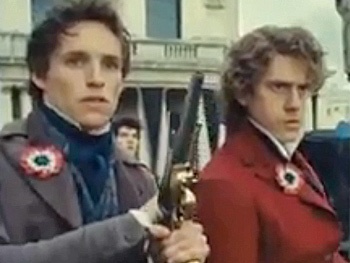
That's much more like it, Marius.
It’s difficult to say whether the expansive, rambling and occasionally incredibly implausible plot of the book is better than the cut-down plot of the musical and the movie. The Eponine-Marius-Cosette love triangle, which really annoyed me in the novel, is greatly improved. Book-Marius has nothing to his character except love for Cosette, and is only interested in the barricade as a way to die when he thinks he’s left her. He’s also an emotionally abusive boyfriend. (“I give you my most sacred word of honor, that if you go away I shall die.” Not on, Marius. Not on.) Musical-Marius is a passionate revolutionary who struggles to choose between his girlfriend, and his friends on the barricade. His relationship with Eponine also changes from a random girl who loves Marius basically on sight to a good friend who provides a genuine  alternative love interest for Marius. In this respect, the writers of the musical did a much better job that Hugo.


On an aside, Hugo wouldn’t know how to characterise a female character if he found one floating in his tea. One day, Cosette looks in the mirror and decides that she’s beautiful. The next: “She at once acquired the whole science of the bonnet, the gown, the mantle, the boot, the cuff, the stuff which is in fashion, the color which is becoming, that science which makes of the Parisian woman something so charming, so deep, and so dangerous.” Yes, Victor Hugo, this is exactly how being a girl works. When she sees a bird making a nest with its mate, she feels “the deep restlessness which a nest gives to a maiden.” Yes, Hugo, all girls work like this, too.


This is sadly the best picture I can find.
He is really much prettier than this.
On the other hand, the revolutionary students, who are some of the best characters in the book, in my opinion (and also some of the few realistic ones), are nothing more but faces in the movie. You miss out on a lot of the rapport between them, and I don’t think you get nearly as much understanding of the fact that as well as being passionate republicans, they’re also just a bunch of friends who like to get drunk and talk politics. I felt like I didn’t get a chance to get to know them before they all died (because remember: everybody dies). I didn’t actually have this problem the first time I saw the musical, before reading the book, but once you know the names of all the revolutionary students, you feel really sad when they only mention the names of two of them. (But don’t worry, because Grantaire is a babe). 

Basically, a movie can’t possibly provide the same depth of character a book can. It can characterise better, as in the case of Marius and Eponine, but it can’t really characterise more. You can fit as much into a book as you want. In a movie, you’re limited by the amount of time people are willing to sit in a cinema before their eyeballs fall out. But that also means that a movie has to streamline and tighten plot, and to keep on topic, which I don’t think it would have hurt Victor Hugo to do just a little bit more.


At the end of the day, the book is too long, but the movie is too short. (Honestly, it would probably make a great TV series). On the plus side, when you read a book, you get to choose which parts you pay attention to, and which parts you skip, whereas if you watch a movie, someone else does the choosing for you. And honestly, I really enjoyed the Battle of Waterloo. I feel educated now. Overall, though, it’s probably best to take book, movie and musical as a whole. The book has deeper characterisation, more complex plot, and will provide you with a thorough grounding in the history of France. It also takes weeks to read. The musical has better characterisation, amazing songs, and lasts for under three hours. And the movie? The movie has Grantaire’s face.