My sister and I have a drinking game. We go into the fantasy section of our local library, and we take turns picking a random book of the shelf and reading the blurb. If the book you pick is set in a standard, somewhat Tolkien-inspired medieval fantasy world (a few dragons, a lot of feudalism, and a strange resemblance to Western Europe), you take a drink.
If we took the trouble to smuggle drinks into our local library, we would end up totally smashed.
The easiest way to illustrate this point is to look at some maps:
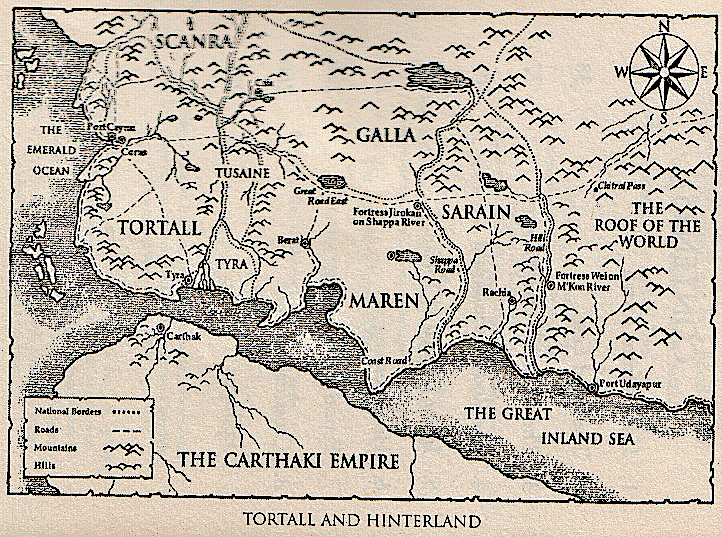 |
| Tamora Pierce's Tortall (source: tamorapierce.wikia.com) |
 |
| John Flanagan's Ranger's Apprentice world (source: rangersapprentice.wikia.com) |
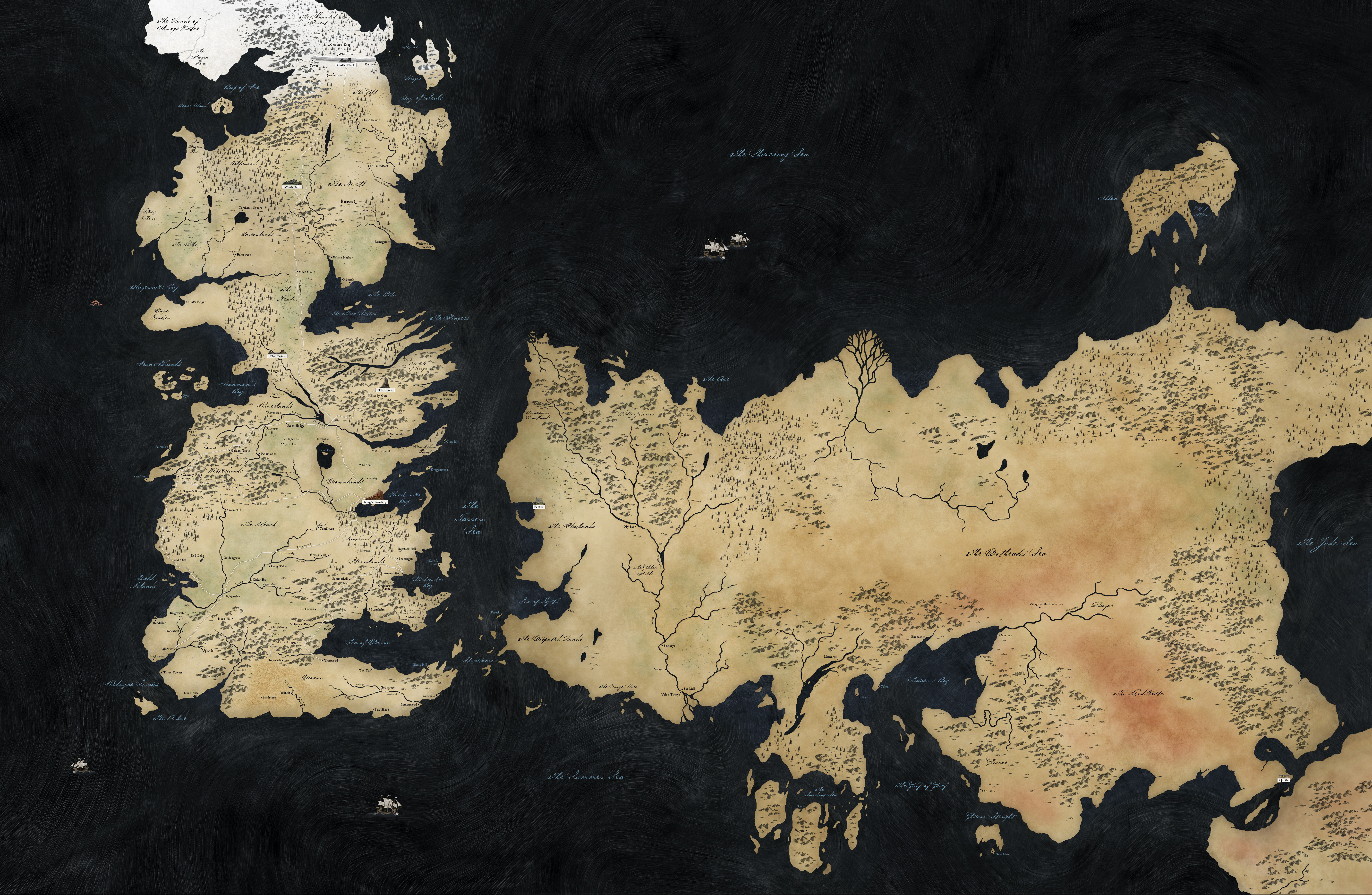 |
| George R. R. Martin's Westeros and Essos (source: gameofthrones.net) |
|

The most obvious answer is that Tolkien did it first. But there’s a slightly more complicated one. The imagined medieval Western Europe is a very familiar place to all of us, not just within the fantasy setting. It’s the location of most of the fairytales we grow up on. It’s the home of King Arthur. If you ask someone to tell a small child a story, the chances they will start with ‘Once upon a time there was a princess living in a castle’ are very, very high. Medieval Europe is not an exotic world that we have to research, or to think about really hard. Since the late medieval story-tellers looked back at the early medieval period and saw an idealised image of knights slaying dragons to win the hands of maidens, it’s been the playground of western story-telling, and so most of us think we’ve got a pretty solid grasp on the medieval world. Thanks to a strange quirk of European culture and historiography, we can lump anything from the early-mid-first millennium all the way to the Renaissance into one supposedly cohesive setting under the ‘medieval’ label, without have to fret too much about whether they’d invented plate mail yet, or how powerful the crossbow was at such and such a time. Chances are nobody will question it. It’s been standard fare for far too long to seem odd.
I haven’t written a medieval fantasy in many, many years. But there’s more to this phenomenon than just the medieval. I sat down to start planning my Nano for this year, and I decided – as I so often do – to write something steampunk. As the people of the fourteenth century invented the chivalric past of the earlier medieval period, I turned around to see an idealised Victorian era - one focussed heavily on the science and progress of the industrial revolution, where nobody ever dies of typhoid.
And so I started out, and I imagined some characters, and I thought about the world they would inhabit, and I assumed it would kind of resemble Victorian Britain. I didn’t even think about this, it just seemed obvious. Want to write a fantasy novel? Set it in medieval Europe! Feeling adventurous. Want to write a steampunk novel? Why move! So vaguely British it was. Nothing specific. Just somewhere where people say things like ‘By Jove!’ and wear top-hats, and there’s some steam-powered stuff, and everyone acts like it’s kind of new and exciting.
That same day, however, while I was doing data entry at my local historical society, I found several files on a magician (unfortunately a stage magician, but I chose to ignore that part of the story in favour of imagining a genuine magician) in Australia in the first half of the twentieth century. He had all kinds of problems unique to his time and place – he struggled to sit his wizardly exams, because there weren’t enough examiners out in the colonies, and those who were there all knew each other, and therefore couldn’t be considered unbiased. He waited weeks, and sometimes months, to receive news from the international magic community. He worried about the decline of magic in the face of exciting new technology. He spoke about the role of women in the magic community. He closed his business during World War Two, because rationing meant he simply couldn’t get hold of the materials he needed.
I contemplated writing a novel about this man, with real magic instead of stage magic. It would be very exciting, and it would be very unique. When was the last time you read a novel about a magician in early twentieth century Australia? Exactly. And when was the last time you read a novel about a magician in a world vaguely based off Western Europe? Well, if you read much fantasy, probably not very long ago at all.
So with this magician in mind, and I turned around and looked at my Nano plan, and I thought – why Britain? Why Western Europe? I’m not British. I’ve only been there once, and that was entirely by accident. And yet I have this idea that if I wrote in Britain – or Western Europe at all – it would be easier. I wouldn’t have to research, and could just write my story, because I pretty much know how Western Europe works – since we started writing about dragons and princesses, ambiguously-dated Western Europe has been the home of fantasy stories.
But if I wrote in Australia, the country I have lived in for my entire life? That would require research. I would have to think about that. I would have to navigate things that haven’t been navigated before: How do Indigenous cultures relate to wizards? How do you build an airship when you’re in a backwater colony in the middle of nowhere an shipping anything over takes months and months? How to you confine a convict who has magical powers? Do we still even have convicts? What year is it? What’s happening in politics? Has Federation happened yet?
And this is where we hit a wall – Australia suddenly seems too specific for a fantasy novel. Suddenly I’m not just writing a fantasy novel, I’m writing an ‘Australian fantasy novel’. But why should Australia be considered any more specific than Britain, or Western Europe? The only answer is that Australia isn’t the default for anybody’s writing, and so there’s no ‘generic Australia’ construction in our general imaginations. Australia needs dates and names and thought, because you’re deviating from the default, and people can’t just place your story in the ‘standard Western Europe’ that they already keep in their heads. To set your fantasy outside of the standard Western European setting, you need to construct your own unique setting from the ground up. You’ve got no default to fall back on.
So I’m picking up my story out of Western Europe, and moving it to a fantastical Australia. It will require some thought, but hopefully I’ll also be writing a better novel, a more unique novel with a stronger setting and less temptation to fall back into lazy tropes. Because other places deserve their fantasy novels too.
(Side note: while writing this post, I got off on a very long tangent about Australia's inferiority complex, and how it manifests itself in our attitude towards the Australian accent. If anyone's interested.)
(Side note: while writing this post, I got off on a very long tangent about Australia's inferiority complex, and how it manifests itself in our attitude towards the Australian accent. If anyone's interested.)

