Thursday, 20 December 2012

Six ways that I didn't write anything, and one way that I did


As you can probably guess from the title, I have been spending far too much time reading fanfiction lately. As though of you who pay close attention to my posting schedule have probably noticed (although I doubt you exist), I have been posting more haphazardly recently than I originally was.
So, to excuse myself for not sticking to the post-every-Tuesday plan which I had when I started, and to assure myself that my life is not wasted, since it serves a warning to others, I present you with a list of what not to do if you intend to write (or do anything, for that matter) productively.

Read Les Mis
In the past two weeks, I have been doing this with my life. A lot. An awful lot. I never fully understood how much writing 1300 pages was until I picked up this book on the ninth of December and decided I should read it before I see the movie this Sunday. On the plus side, you – my lovely, although I suspect largely imaginary, readers – will get a review of this enormous tome at some stage in the next few weeks. On the minus side, it’s time consuming. If you want to get anything else done, do not read this book in a short space of time. Or more broadly, if you like – if you know a movie is coming out at the end of the year, read the book at the start of the year, or in the middle, or at some other normal time that doesn’t require you to set page-per-day goals. Leaving things to the last minute turns out not to be conducive to doing other stuff at the same time. Blogs, fanfiction, and that legit novel I sometimes pretend to be writing tend to fall by the wayside.

Discover Deviant Art
Don’t do it. Never go there. Ever. For the nine years of my life since I first discovered the horror that is fandom, I have managed to avoid this website. I always knew it existed, and I never felt any desire to go there. Life was good.
And then, the other day, I decided that to accompanying my reading of Les Mis, I needed pictures of the characters. You know, to visualise them properly in my head. Important and entirely legit stuff.
It’s like TV Tropes. Once you arrive, you will never, ever, leave. Because how can you abandon dashing young Frenchmen such as this?
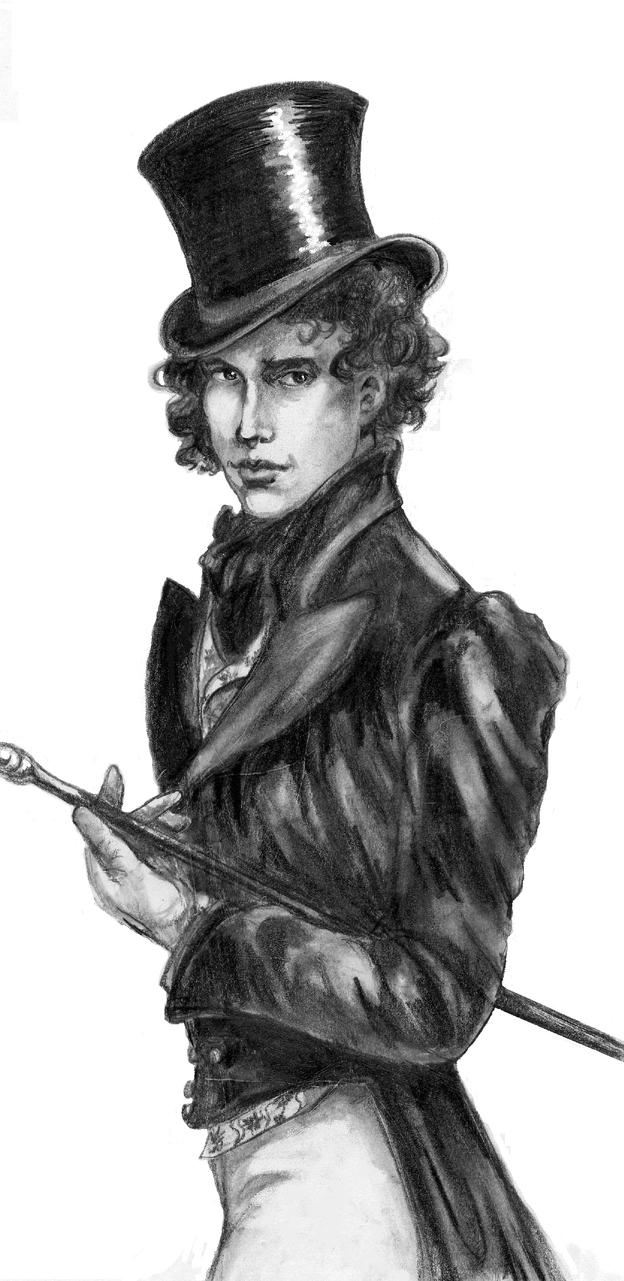
Why hello there, Montparnasse.
(Colonel Despard, Deviant Art)
   
Fall behind
I said to myself, when I began this blog, that I would write a post every Tuesday. It was an excellent plan, and it lasted several weeks. And then I missed a Tuesday. So then I wrote on Wednesday. And then I didn’t know whether to do the next week’s on Tuesday or Wednesday, and so I figured it didn’t really matter. And so I wrote it on Friday. And then on Tuesday I’d written so recently that I figured it didn’t really matter if I missed today, because I could write one tomorrow. This is how it works, until you suddenly realise that you haven’t written anything in weeks. It applies to writing novels, as well as blog posts, and it is very dangerous. Unless you have a good reason – the end of the world, for example – if you set yourself a writing goal, keep it. It’s for your own good, truly.

Do research
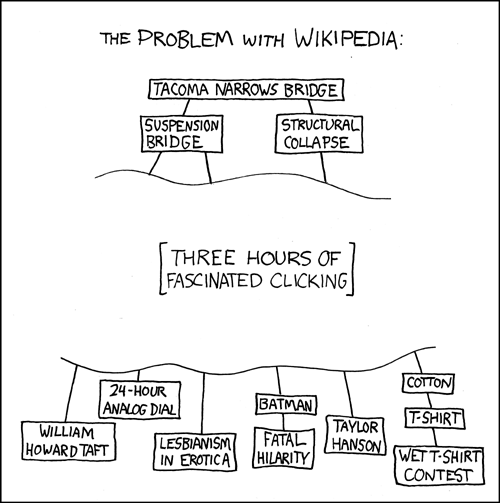
xkcd understands.
Last week I posted about how much research is too much research, in terms of historical fiction. I don’t know the answer, but I have worked out that there’s a point when research becomes procrastination. When onne begins by reading through lists of names to decide what the murder victim in Is-it-Republican-Rome-or-1800s-France ought to be called, and ends by learning that there is a text adventure game in Latin (Are you excited? I’m excited too!), one is procrastinating. Wikiwalks are not a way to get things done. Remember: the Internet is a dangerous place, a lot like a black hole.


Forget your writing exists
Yes, I did this the other week with this very blog. I’m lucky I have a sister around to remind me. If you spend too long procrastinating, and reading long books, and telling yourself that you will be able to write (or perhaps edit) the next scene tomorrow, this will happen. It’s true. And then the novel that you’re working will slowly become forgotten, and be relegated to that folder of documents that you sometimes look in, and open, and you’ll go, “Oh, I remember this. It was actually pretty good. Too bad I can’t remember what was going to happen. I wonder why I stopped writing…” And that will be the tragic death of what could have become the next Harry Potter. Alas.

Write
If you don't have an iPhone...
Yes, I went there. It’s cliched and possibly the most said thing in the world of writing, but honestly, it’s a lot like owning an iPhone. If you don’t write anything, you won’t have written anything. I don’t think it has to be lots of writing, or anything scary like ‘You have to write every day or else you will die’, but the moral of this story is that if you don’t write anything, you will eventually forget it was there to write. And while nineteenth century Frenchmen are very distracting, and I’m greatly looking forward to playing Labyrinthus Latinus, I would trade definitely browsing Deviant Art for pictures of Les Amis L’ABC today for potentially being able to browse Deviant Art for fanart of my own characters in the future any day. And if I don’t write a novel first, there will be no characters for my legions of future fans to draw. And that will be a great loss to the world.

Friday, 14 December 2012

Researching Historical Fiction


As well as failing to regularly update my blog, on account of holidays and the need to read the entirity of Les Mis in the two weeks before the movie comes out, I have been writing fanfiction of sorts about Cicero and Enjolras solving crime. Unexpectedly – yes, I didn’t see this coming – this has led me into the realm of historical research. I was intending for it to be a small writing project that I didn’t have to think about seriously, but of course, things never stay that way. I spent several hours the other day reading up in great detail on Cicero, to try and gauge how he would respond to being called a patrician. My several hours of reading the works of Cicero, and then any other writings I could get my hands on on the internet about Cicero left me with nothing but a throw-away line that will be read in under a second. But it did raise the question – how much research is too much?


I’m sure this is a problem that plagues anyone who tries to write historical fiction, and much more so those who try to write legitimate fiction that some bizarre sort of fanfiction mash-up, but nonetheless, it’s a problem. Is it really worth three hours of reading to get one line that doesn’t reveal anything at all? On the one hand, I did learn that Cicero was horrible arrogant, but also very witty, and that I’ll have to study Oscar Wilde before I can write proper Cicero fanfiction. It definitely helped me to get my head around his personality, as well as the setting.


On the other hand, it means that rather than write several pages – or at the very least one page – in a sitting, I’ve been moving at about a sentence a day. Even though I’m writing what I plan to be a short story, this could take me a long, long time.


In search of answers, I headed off into the blogosphere. I found advice ranging from “do the most research you possibly can” to “find a happy medium” to “you can write your story and then do the research”. The first raises the obvious problem that if you do the most research you possibly can, you will wind up a very old academic expert, with no historical fiction to your name. On the other hand, if you write before you research, your story might inadvertently hinge on something that couldn’t possibly have actually occurred, and the whole thing with fall to pieces. And as for finding the happy medium – it’s a great piece of advice, but where? and how? Beyond suggesting that you have to get your head around vagaries of speech and dress, nobody seems to have any idea.


I don’t have a solution to this problem yet, so I’m mostly writing this post in the hope that someone will comment with a magical answer. I don’t think there is one, but I like to pretend there might be. Does anyone have an answer? Have do you find the balance between research and writing?

Wednesday, 21 November 2012

Reports from the No-Longer-Novelling Front, and a Book Review


Nanowrimo

So I’ve given up on Nanowrimo. Turns out that having done Nano four years running does not qualify you to do a double-Nano. Some people have this kind of stamina. I do not. I will know this for next time, because it really isn’t worth the effort. I probably ought to have just made up my mind on one novel at the start of the month, accepted that I could write the other one at a later date, and moved on. And then, feeling overwhelmed by trying to write two Nanos and an essay on Livy, I decided to take a few days off. On the plus side, I learnt a valuable Nanowrimo lesson:  I should never take days off. Especially not when there is good weather, and I end up sitting outside, thinking thoughts like ‘Why would I want to go inside and write a novel?’ and ‘Ceebs.’

 Surprisingly, something else which I think may have potentially been a problem is the fact that one of my novels was meticulously planned, down to detailed scene lists. I think I felt less motivated to write because I already knew what happened, and so my characters will never be stuck in awkward limbo where no-one ever finds out how they resolve things. I know how they resolve things, and I wasn’t interested enough in exploring it in more detail. I hadn’t actually predicted this negative outcome of planning, but there you go. Perhaps I’m doing it wrong. Perhaps planning just isn’t a thing for me. I’m not entirely sure, but I think it may just have been the fact that my plan was so detailed that it was stifling anything unexpected. There is probably a nice balance I can find.

Honestly, though, it’s not all bad. I’m not exactly lacking in first-draft manuscripts that seriously need editing. One is hiding on my computer not being looked at, one is in the middle of becoming a second draft, and one is waiting to be converted into a musical. and then there’s a screenplay waiting to become a web-comic. And a half-finished novel about uber-talented artistic prodigies at boarding school. It don’t think I actually need Nanowrimo to make sure I write things at this point. Things get written. Now they just need to be made good.

And then, of course, there was the curse that strikes so many Wrimos – I had a brilliant idea for another story, that would be so much more fun to write. I call it ‘Cicero and Enjolras Solve Crime’. It will be amazing.

And now for a book review…


The House of Silk – Anthony Horowitz

I’ve been meaning to read this book since I first learnt that it was going to exist. It’s a new Sherlock Holmes novel, authorised by the Conan Doyle Estate. They don’t usually go around authorising things, so this is all very exciting stuff, for fans such as myself.

Like most – though sadly not all – Holmes stories, this one is written in first person, from Watson’s point of view, opening with this lovely sentence: “I have often reflected upon the strange series of circumstances that led me to my long association with one of the most singular and remarkable figures of my age.”

As one can see, from the very beginning, Horowitz does an excellent job of picking up Watson’s voice, even managing to get in the important Watsonian adjective ‘singular’, of which the man is ridiculously fond. In fact, the opening chapter or two are so well-voiced that I was starting to feel a peculiar sense of having read them before. Luckily, the plot itself is original enough that this isn’t a problem, and by the time I was in the middle of the novel, I had completely stopped worrying about things like the authenticity of Watson’s voice. Also in terms of voice, Horowitz’s Watson is more introspective than Doyle’s ever was. This is explained by the fact that the novel is supposedly written by an old Watson after Holmes is long dead, whose remaining joy in life lies in reminiscing about his time with Holmes. It felt to me a little out of character for Watson to go off on as many reflective tangents as he did, but given the legitimate explanation, I’ll give Horowitz that one. Overall, in the sounding-like-Watson stakes, it was a job well done.

I was very impressed, too, with how Horowitz dealt with Watson’s wife – or rather, conspicuous lack thereof. It’s always been one of those problems in Sherlock Holmes novels – Watson gets married, probably several times, and yet his wives just kind of disappear, fading into the background to his adventures with Holmes. Horowitz addresses this early on, getting the wife out of the way on a long visit to an old employer. Conan Doyle could have tried this easy plot device, and saved many readers a lot of  “But wait, Watson, aren’t you supposed to be married right now? Do you ever even mention your wife?”

The story itself starts and finishes quite Holmesianly (yes, it’s a word), but a large chunk of the middle is oddly – not meandering as such, but tangental to what one would have expected. In a vague, non-spoilery way: Holmes and Watson start off solving one crime, which leads them to discover the next crime, which leads them to the next crime, and so on and so forth. So for a long time you’re just jumping from mystery to mystery, and you never actually go back and find out what the solution to each one is until the very end. It’s a little bit disorienting, and – as Watson kindly puts it within the novel – “I found it hard to make the necessary connection, which is to say, I was quite lost as to how [spoilers] could possibly have led us to our present pass. Here was a paradox indeed.” Yes, it was. I don’t think this was necessarily a bad thing, but if you’re the sort of person who likes to keep all the facts straight in your head and solve the mystery yourself as you go along, you’re in for a trying time.

All in all, I enjoyed the book immensely. I wouldn’t say it’s as good as the best Holmes short stories (‘The Adventure of Charles Augustus Milverton’, anyone?), but then again, I always thought Holmes and Watson were more suited to the short-story format than the novel. As a Sherlock Holmes novel goes, it’s definitely the up there (and far superior to the Mormon chapters of A Study in Scarlet).